
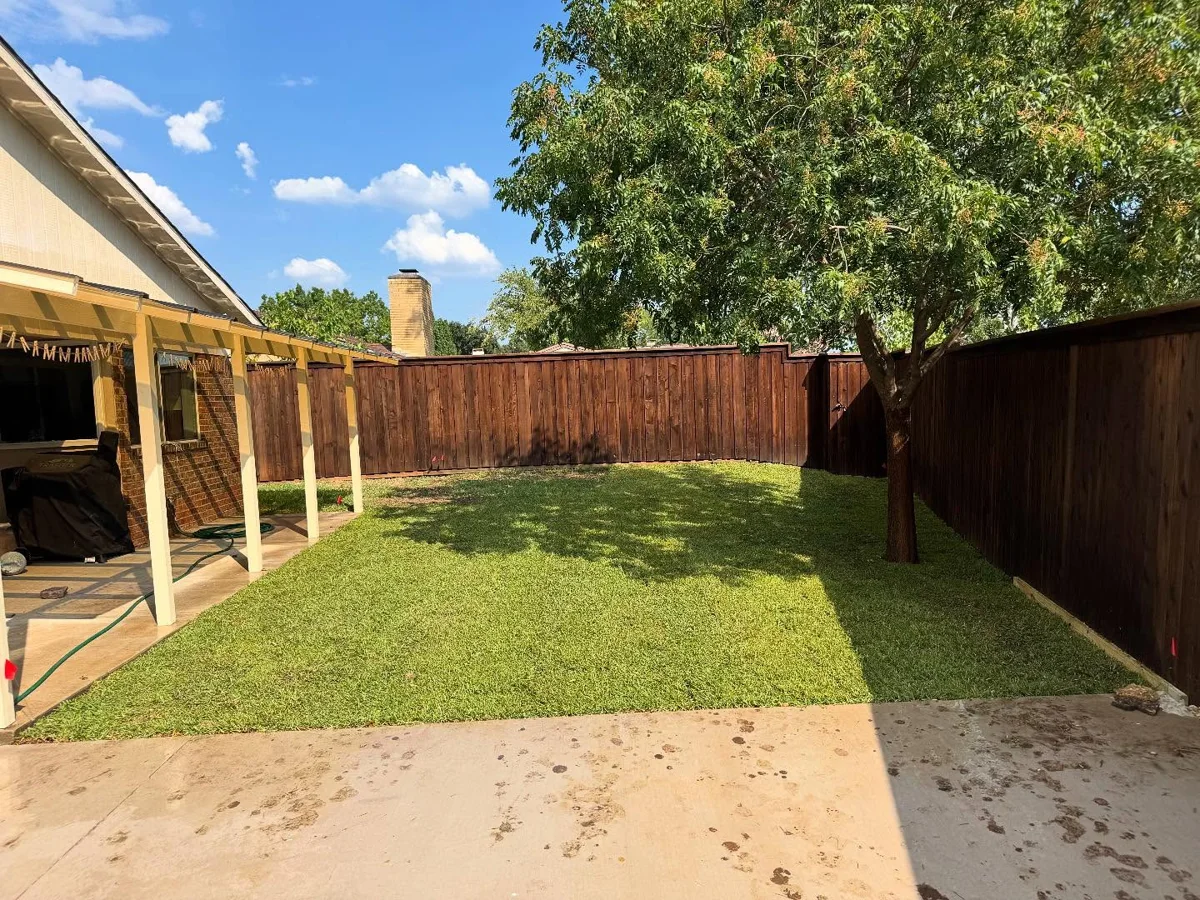
The short answer: St. Augustine for shade, Zoysia for part shade
St. Augustine is the best sod for shade in Dallas-Fort Worth. Texas A&M AgriLife lists shade tolerance as its first strength and calls it the most shade-tolerant warm-season grass. It still needs light. AgriLife puts the daily minimum at four to six hours, and that minimum varies by cultivar and by the kind of shade.
- Raleigh St. Augustine ($259 a pallet): the North Texas standard. It holds at four to six hours of sun and handles DFW winters better than other St. Augustines.
- Palmetto St. Augustine ($325 a pallet): goes into a little more shade than Raleigh, with a softer blade.
- CitraBlue St. Augustine ($359 a pallet): a newer cultivar with improved shade tolerance and a blue-green color. Supply is limited.
- Palisades and Zorro Zoysia ($380 and $380 a pallet): both handle four to five hours of sun. AgriLife notes that Zoysia matrella types are more shade tolerant, and both of these are crosses with Zoysia matrella.
- Bermuda: needs six or more hours of direct sun. AgriLife lists shade tolerance as Bermuda’s main weakness. Celebration copes with a few trees better than most Bermudas, but it is still a sun grass.
Floratam is a St. Augustine, but it prefers sun and is more sensitive to cold, so it is not a shade pick for DFW. Emerald Zoysia also asks for good sun. Compare all three families in Bermuda vs. St. Augustine vs. Zoysia.
Count the sun hours in your yard
Do this on a clear day in the growing season, when the trees have their leaves. Winter sun through bare branches will mislead you.
- Morning, around 9: walk the yard and note which areas have direct sun on the ground.
- Midday, around noon: check the same areas again.
- Afternoon, around 3 and again around 5: check once more.
Each check where an area has direct sun stands for roughly two to three hours of light. Mark each area on a phone photo of the yard. You will usually find two or three zones: open sun, part shade, and heavy shade.
Two details change the count. First, AgriLife notes that warm-season grasses respond better to afternoon light than to morning light, so four hours of afternoon sun beats four hours of early morning sun. Second, filtered light through a tree canopy is different from the solid shadow on the north side of a house. Dappled light all day can still support St. Augustine; a wall that blocks the sun for most of the day may not.
Pecans, live oaks, and other trees
Trees cause most shade problems in established DFW neighborhoods. AgriLife makes two points that matter here. Grass competes with trees for water and nutrients, and a growing tree casts a little more shade every year. A lawn that did well under a young pecan can thin out ten years later without any change in care.
You can often give the grass more light without losing the shade:
- Raise the canopy. Removing low-hanging limbs lets in reflected light from the sides.
- Thin selected limbs. Removing a few branches lets more light through the canopy. Use a qualified tree professional for large trees.
- Leave the roots alone. AgriLife advises against adding soil over tree roots without a horticulturist’s advice. Do not pile topsoil around a trunk to level a new lawn.
Do the sun count under each tree separately, in summer when the canopy is full. A dense live oak and an open, high pecan can leave very different light on the ground beneath them, and averaging them across the yard hides the difference.
When no sod will grow
Some areas are too shady for any lawn. AgriLife puts it plainly: if a spot is too shady for St. Augustine, it is too shady for any warm-season grass. Deep, all-day shade with no dappled light is the typical case: under a dense live oak, between two houses, or beneath a low deck.
Grass laid there will thin out, and the bare soil compacts and invites weeds. More water or fertilizer will not compensate for missing light. AgriLife suggests mulch, shade-tolerant perennials, or beds in these areas. Leave those areas out of your measurement and plan beds or mulch instead. Your sod order will be smaller and the lawn you keep will look better.
Mix grasses by zone
Many DFW yards use two grasses: St. Augustine under the trees and Bermuda in the open sun. This works well when each grass goes where its light suits it.
- Draw the boundary on your sun map, then make it a clean, straight cut or follow a bed edge or walkway.
- Bermuda spreads by stolons above ground and rhizomes below ground, so expect to edge the seam to keep it from creeping across.
- Mow each zone at its own height. Bermuda is mowed at 1 to 2 inches and St. Augustine at 2.5 to 3.5 inches, so cut the zones separately or reset the deck at the seam.
A part-shade yard that should look like one lawn can use Palisades or Zorro Zoysia for the whole area, as long as every area gets at least four to five hours of sun.
Mowing and watering in shade
Mow higher. AgriLife recommends 2.5 to 3.5 inches for St. Augustine and taller heights in moderate shade, because more leaf area means more light captured. Keep shaded St. Augustine near the top of that range and shaded Zoysia near the top of its 1 to 2 inch range. Never remove more than one-third of the blade in one mowing.
Water and feed less in the shade. Shaded grass uses less water and fertilizer than grass in full sun, and AgriLife warns that overwatering and overfeeding shaded turf increase disease. If the sprinkler system runs the shady zone on the same schedule as the sunny zone, give the shady zone a shorter run time once the sod has rooted. Water in the early morning; evening watering keeps the leaves wet longer and favors disease.
New sod is the exception. Until it roots, sod in shade still needs a moist root zone. We recommend installing sod where irrigation is close at hand and available for use. Check under a corner before each watering, and follow the new-sod watering guide.
Plan the order
Measure each zone separately and leave out the areas you will plant as beds. One pallet covers 450 square feet. Our satellite measuring tool lets you draw each zone on the map. Delivery runs $95 to $250, depending on the address. Installed St. Augustine starts from $850 a pallet installed, and the final price depends on the grass and the prep the yard needs.
Compare the shade grasses on the St. Augustine page and the Zoysia page, and the sun grasses on the Bermuda page. For grass selection, soil prep, and watering together, read the complete guide to sod in Dallas-Fort Worth.
Get a free estimate. Send your square footage per zone, a photo of the shaded areas, and the tree types, and we will recommend a grass for each zone.
Questions people ask
Can St. Augustine grow in full shade?
No. It is the most shade-tolerant warm-season grass, but Texas A&M AgriLife puts its daily minimum at four to six hours of light. Deep, all-day shade with no dappled light is better planted as beds or mulch.
Is Zoysia or St. Augustine better for shade?
St. Augustine takes more shade. Palisades and Zorro Zoysia handle four to five hours of sun and suit part shade. Under a dense canopy, choose Raleigh or Palmetto St. Augustine.
Will Bermuda grow under trees?
Bermuda needs six or more hours of direct sun and thins out under trees. Use it in the open sun and St. Augustine in the shaded zone, with a clean seam between them.
Should I mow grass in shade higher?
Yes. A taller cut leaves more leaf area to capture light. Keep shaded St. Augustine near the top of its 2.5 to 3.5 inch range and never remove more than one-third of the blade at once.
Does grass in shade need more water?
No. Once rooted, shaded grass usually needs less water and fertilizer than grass in full sun, and too much of either raises disease risk. New sod still needs a moist root zone until it roots.
Sources
This guide is part of The complete guide to sod in Dallas-Fort Worth.